
Try a small experiment the next time you rewatch a favorite film. About halfway through a tense scene, mute the sound. The actors keep moving, the danger is still on screen, but something drains out of the moment. The dread thins. The scene that once had you holding your breath now feels oddly flat, almost like footage from a security camera. Nothing on screen changed. What vanished was the music.
We tend to talk about movies as a visual medium, and directors and cinematographers get most of the credit for how a film makes us feel. But a huge share of the emotional work happens through our ears, often without us noticing. A good score doesn't announce itself. It slips underneath the images and quietly tells you how to feel about them — sometimes before your conscious mind has even caught up.
The best film music is the music you don't remember hearing, because you were too busy feeling what it wanted you to feel.
This piece is a tour of how that invisible craft works: why a few notes can flood a scene with meaning, how composers build musical "characters," and what to listen for so you can appreciate the machinery without breaking the spell.
Sound Reaches You Before Thought Does
Part of why music is so powerful in film is a matter of timing. Vision is something we analyze; we scan a frame, read expressions, work out what's happening. Sound tends to hit faster and lower, closer to instinct. A sudden low rumble can put your body on alert a full second before you consciously register that something is wrong. Composers exploit that head start constantly.
The clearest example is the pulse. A steady, quickening beat under a chase scene doesn't just accompany the tension — it creates part of it. Your heart rate has a subtle tendency to fall in line with a strong external rhythm, so a score that accelerates literally nudges your body toward the feeling of pursuit. Slow, spacious music does the reverse, giving your nervous system permission to settle. The film hasn't told you anything in words. It has simply set the tempo of your attention.
Researchers who study film music describe several overlapping mechanisms at play: music primes anticipation, deepens empathy for characters, and strengthens how vividly we remember a scene later. You don't have to know any of the theory for it to work on you. That's the point. The score is aimed at the part of you that reacts before it reasons.
The Leitmotif: Giving a Character Its Own Tune
One of the oldest and most effective tricks in a composer's kit is the leitmotif — a short, recognizable musical phrase tied to a specific character, place, or idea. Every time that person appears or that idea surfaces, some version of their theme returns. The technique predates cinema; it comes from opera, where composers used recurring themes to track who was who across hours of music. Film adopted it almost immediately, and it has never let go.
What makes a leitmotif so useful is that it turns music into a form of memory. The first time you hear a hero's theme, it's just a nice melody. But because it plays during moments of courage and triumph, your brain quietly links the two. By the third or fourth time, the melody alone can raise a lump in your throat, even in a quiet scene where nothing dramatic is happening. The music is cashing in on everything you've already felt.
Think of a long film series where the same central theme returns across many installments. When that familiar melody swells years later, it doesn't just sound pleasant — it drags a whole history of attachment with it. That's a conditioned response, built patiently over hours of screen time. Composers can also bend a leitmotif to tell a story on its own: play a hero's confident theme in a minor key, slow it down, hollow out the orchestration, and you've told the audience the hero is broken without a single line of dialogue.
Tension and Release: The Score as a Set of Hands
Beyond individual themes, a score shapes the overall emotional shape of a scene through a constant dance between tension and release. Music builds pressure by leaving things unresolved — a chord that leans forward and refuses to land, a rising line that keeps climbing, a dissonance that scrapes against your expectations. Then, at the right moment, it resolves, and the release feels like exhaling.
Horror and suspense films are the most obvious practitioners, but the mechanism is everywhere. A romance withholds its main melody through a couple's near-misses and finally lets it bloom when they come together. An adventure holds back the full brass statement of its theme until the exact frame the hero commits to the quest. The delay is deliberate. Give the audience the payoff too early and it means nothing; make them wait, and the same notes land like a wave.
Film music works less like a narrator telling you what's happening and more like a pair of hands, tightening and loosening around your attention.
This is also why silence can be one of the loudest tools a composer has. After a long stretch of scoring, cutting the music entirely can make a moment feel suddenly, dangerously real. The absence works only because of everything the music did before it. You notice the quiet precisely because your ears had grown used to being guided.
Diegetic or Not: Where Is the Music Coming From?
A useful distinction for any curious viewer is whether the music exists inside the story or outside it. Diegetic music has a source in the world of the film — a car radio, a bar band, a character humming. The characters can hear it. Non-diegetic music is the score proper: the swelling orchestra that no one on screen could possibly be listening to. Most of what we've been discussing is non-diegetic, the invisible commentary layered on top of the scene.
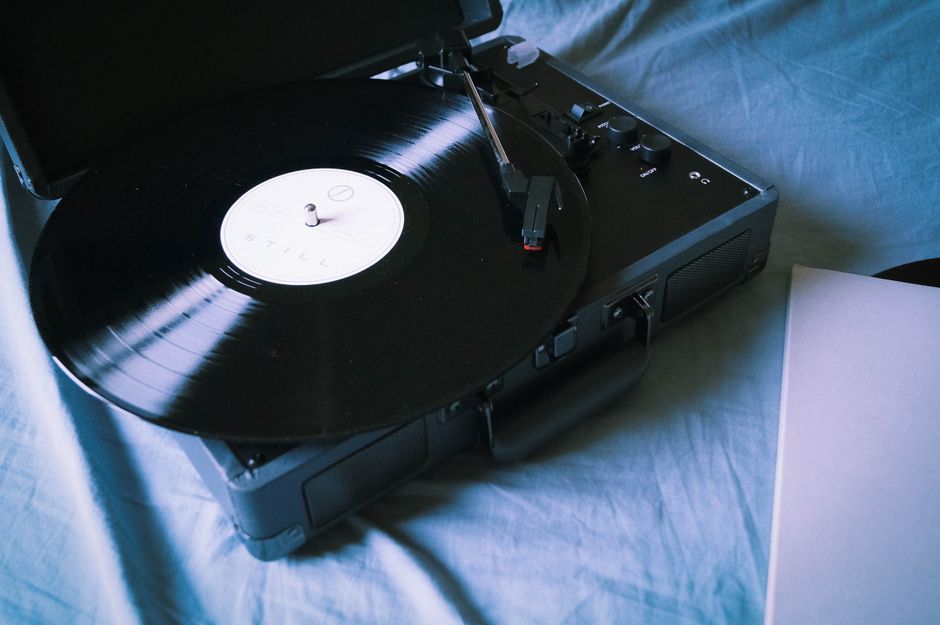
Filmmakers love to play with the line between the two. A song might start as something a character puts on a record player, then swell and take over the whole soundtrack as the scene turns dreamlike — sliding from diegetic to non-diegetic so smoothly you barely notice the crossing. Sometimes the trick runs the other way, when a piece of "score" is suddenly revealed to be coming from a musician within the scene, collapsing the distance between us and the story.
Once you start listening for the source of the music, you notice how often films use it deliberately. A cheerful pop song blaring from a diner jukebox during a grim conversation creates irony no line of dialogue could match. The mismatch between what we see and what we hear becomes its own kind of storytelling.
How to Listen Without Ruining the Magic
You might worry that paying attention to the score will break the illusion — that once you see the strings being pulled, you can't be moved anymore. In practice, the opposite tends to happen. Noticing the craft usually deepens the admiration, the way learning a bit about cooking makes a great meal more impressive rather than less.
A gentle way to start is to pick one film you know well and watch a single scene twice. The first time, just feel it. The second time, ask a few questions. When does the music come in, and when does it drop out? Is there a melody that keeps returning, and does it change when the character's situation changes? Is the score racing ahead of the action or lagging behind it? You'll quickly find that the choices are rarely accidental.
From there, you can widen out. Notice how different genres carry different sonic fingerprints, how a composer's style follows them from film to film, how a single well-placed theme can do the work of a page of script. None of this requires reading music or knowing the terminology. It just requires listening on purpose to the layer you usually absorb without thinking.
The Takeaway
Film scores are one of the great sleight-of-hand acts in popular art. They shape our heartbeat, hand us characters' emotions before we've earned them, wind us tight and let us go, and mostly they do it while staying out of sight. The music you don't notice is doing an enormous amount of the feeling on your behalf.
So the next time a movie leaves you unexpectedly moved, spare a thought for the part of it you couldn't see. Somewhere under the images, a few carefully chosen notes were quietly telling your body what to do — and you, wonderfully, let them. Watch one favorite scene again this week with your ears wide open. You may never hear movies the same way, and that's a gift, not a loss.

Comments 0