
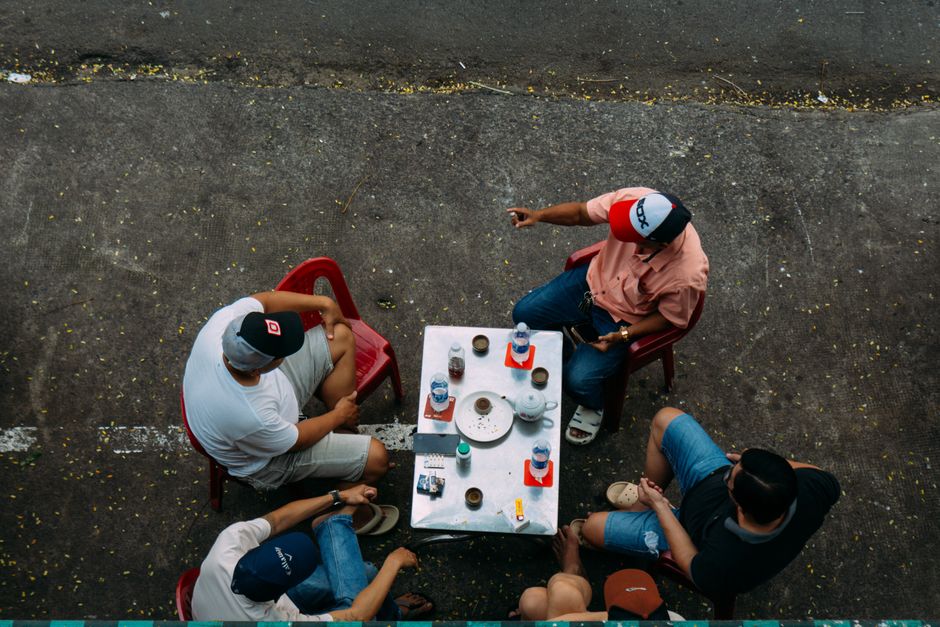
There is a specific moment a lot of people hit somewhere in their late twenties or thirties. You are at a wedding, or a work offsite, or a housewarming, and you meet someone you actually like. Real conversation, easy laughing, the kind where you both lose track of the time. You exchange numbers. You say "we should do this again" and you both mean it.
And then nothing happens. Not because either of you decided against it. Because Monday came.
If that pattern feels familiar, you are not socially broken and you have not aged out of friendship. What has actually changed is the machinery underneath it — and once you see the machinery, the problem stops feeling like a personality flaw and starts feeling like a logistics problem you can solve.
The thing school gave you for free, and no longer does
For most of your life, friendship was a byproduct. You did not schedule it. You showed up somewhere five days a week, sat near the same people for months, had nothing urgent to do afterward, and friendships condensed out of that like water on a cold glass.
Sociologists have a tidy description of what those environments provided: repeated unplanned contact, in a shared setting, with enough unstructured time that people could drift into conversation. School has all three. A college dorm has all three. A first job at a company where everyone is twenty-four has all three.
Adult life systematically removes them. Remote and hybrid work removes the shared setting. Calendars removes the unstructured time. And the single biggest one: after a certain age, almost nothing puts the same group of near-strangers in the same room week after week without a purpose attached.
You did not lose the ability to make friends. You lost the environment that used to make them for you.
That reframe matters because the two diagnoses lead to completely different actions. If you believe you have gotten worse at connecting, you will work on your personality — which is slow, vague, and mostly unnecessary. If you believe you lost an environment, you will go rebuild one, which is concrete and achievable.
The number that explains everything
In 2018, Jeffrey Hall, a communication researcher at the University of Kansas, published a study that tried to answer a question most people never think to ask: how much time does becoming friends actually take?
He ran two studies — a survey of 355 adults who had moved to a new city within the past six months, and a nine-week tracking study of 112 first-year students who had just relocated. He asked people how many hours they had spent with a new acquaintance and where that person now sat on a closeness scale.
The rough thresholds he found:
| Transition | Approximate hours together |
|---|---|
| Acquaintance → casual friend | ~50 |
| Casual friend → friend | ~90 |
| Friend → close friend | 200+ |
Two details in that research are more useful than the headline numbers.
First, not all hours count the same. Hall found that time spent working alongside someone contributed far less than time spent hanging out, joking around, playing games — time with no deliverable attached. This is the quiet reason so many people are close-adjacent to their coworkers for years without ever becoming actual friends. You can log 2,000 hours with someone in meetings and still not know what they are afraid of.
Second, and this is the part that should change your behavior: 50 hours is not a big number if the time is recurring, and it is an impossible number if it is not. Two hours a week gets you to casual friend in about six months without either of you doing anything heroic. A three-hour dinner every four months gets you there in five and a half years, which is to say never.
So the whole problem compresses into one design question: what is the thing that repeats?
Stop trying to make friends. Build the container instead.
The standard advice — "put yourself out there," "say yes to more invitations," "join something" — is not wrong, but it is aimed at the wrong layer. It treats each social event as a chance to meet a friend, when what you actually need is a structure that generates dozens of low-stakes hours with the same people over months.
Think about what you are looking for as a container: a recurring thing, at a fixed time, with a roughly stable set of humans, that would happen whether or not you were feeling social that week.
Good containers share a few traits:
- They recur on a schedule you don't have to renegotiate. Tuesday at 7 forever beats "let's find a time." Every renegotiation is a chance for the thing to die.
- They have a reason to exist besides friendship. A run club, a climbing gym, a choir, a language class, a volunteer shift, a board game night, a pickup league. The activity carries the conversation on the awkward early nights when no one has anything to say.
- They are small enough that you're missed. In a 200-person gym class you're anonymous. In an eight-person group, your absence is noticed — and being noticed is what turns attendance into belonging.
- The barrier to showing up again is low. Cheap, close to home, and short enough that a tired version of you would still go.
Notice how few of those criteria have anything to do with charisma. This is mostly a scheduling problem wearing the costume of a personality problem.
If nothing suitable exists near you, the underrated move is to start the container yourself. It sounds like a huge undertaking; in practice it is a message that says "I'm doing a walk-and-coffee on Saturday mornings at 9, same spot every week, come whenever you want." You will feel like a dork sending it. Someone will come.
The second invitation is the whole game
Here is where most adult friendships actually die: not at the first meeting, but in the silence that follows a good one.
The pattern is almost always the same. You meet someone, it goes well, you both say "let's do this again," and then both of you wait — not out of disinterest, but because reaching out first feels like admitting you liked them more than they liked you. It's a stalemate where both sides think they're being polite.
The research on this is unusually encouraging. Studies on what psychologists call the liking gap have repeatedly found that after a conversation, people underestimate how much the other person enjoyed it and how much they were liked. Your read on the interaction is systematically more pessimistic than the truth. The other person walked away thinking it went better than you assumed they did.
The awkwardness you're bracing for when you text someone first is a tax you're paying on a threat that mostly isn't there.
So the practical move is embarrassingly small: be the one who follows up, and be specific. Not "we should hang out sometime," which is a pleasantry and dies as one. Instead: "There's a food market on Sunday morning near me — want to go?" A specific proposal with a time in it is either accepted or declined. A vague one is neither, forever.
And if they can't make it, propose the next one anyway. Two declined invitations mean nothing. Adults are busy in ways that have nothing to do with you.
What to actually do in the hours
Once you have the container and the follow-up habit, the last piece is what happens inside the time — because 50 hours of surface-level chat will make you familiar, not close.
The shift from acquaintance to friend usually happens through small, incremental self-disclosure that gets reciprocated. Someone mentions a real thing — a worry about a parent, a job they're unsure about, a hobby they're mildly embarrassed by — and the other person meets it with something equally real instead of deflecting into advice or a joke. That exchange, repeated, is basically what intimacy is.
A few things that make it more likely:
- Ask the second question. Most conversations stop at the first answer. "How was the trip?" → "Good." → "What was the best part?" The second question is where the actual person shows up.
- Volunteer something slightly unguarded first. Disclosure is contagious, and someone has to go first. It doesn't need to be heavy. Mild and honest beats deep and performative.
- Remember one detail and bring it back next time. "How did the presentation go?" three weeks later does more for a friendship than an hour of good conversation. It's proof you were listening when nothing was at stake.
- Protect some unstructured time. If every meeting is an activity with a start and end bell, you never get the loose, purposeless stretch where the good conversations live. Build in the coffee after the run.
None of this is a technique to deploy on people. It's just a description of what closeness is made of, so you can stop expecting it to arrive on its own.
Why this is worth the trouble
It would be easy to treat all of this as optional — a nice-to-have you'll get to once work calms down. The evidence says otherwise. The U.S. Surgeon General's 2023 advisory on loneliness and social isolation pulled together decades of research and concluded that lacking social connection raises the risk of premature death by a margin comparable to smoking 15 cigarettes a day, alongside elevated risk of cardiovascular disease, dementia, depression and anxiety. About one in two American adults reported experiencing loneliness even before the pandemic made it worse.
That is not a guilt trip. It's a rebalancing of the ledger. Most people treat friendship as the thing that fills the gaps left by work, family and obligations — the residual. The health data suggests it belongs closer to the category we put exercise and sleep in: not a reward for a well-managed life, but part of the maintenance that makes one possible.
So the summary, if you want the short version:
Friendship in adulthood doesn't fail because you got worse at it. It fails because the environment that used to manufacture it quietly disappeared, and nobody handed you the replacement. The replacement is a recurring thing at a fixed time with the same people, plus a willingness to send the second invitation before you're sure it's welcome, plus enough honesty in the hours to let someone actually know you.
It takes months. It will feel slow and slightly awkward at the start, and there is no version where it doesn't. But somewhere around the fifth or sixth week of showing up, something shifts — someone saves you a seat, or texts to ask if you're coming — and you realize the thing you thought you'd lost the ability to do was mostly just waiting for you to put it on the calendar.
Send the text. Pick a Tuesday.


Comments 0