
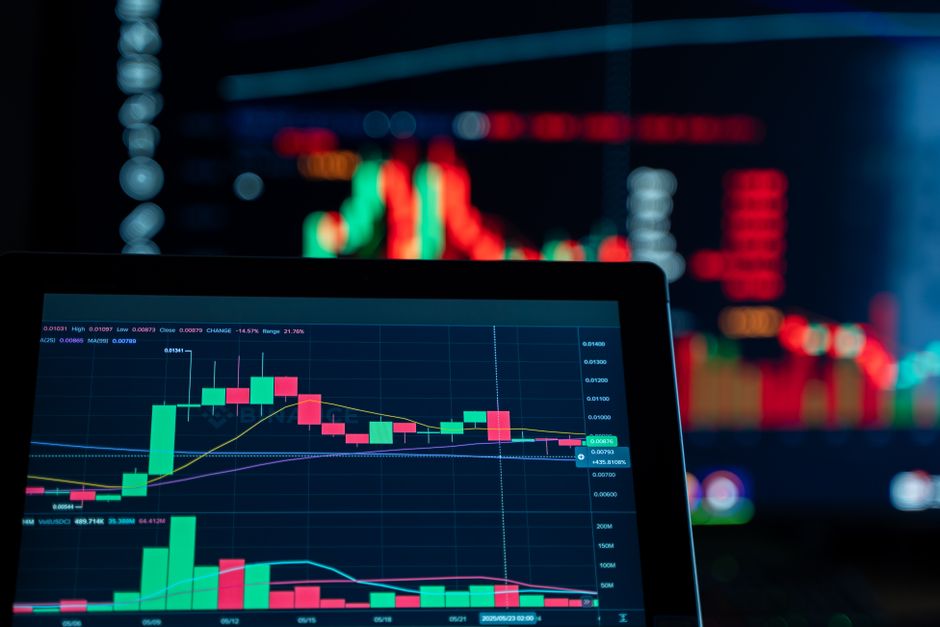
Seoul's chip trade did it again. The KOSPI pushed above the 7,000 mark for the first time in fifteen sessions on Friday, tapping an intraday high of 7,010.86 before profit-taking pulled it back to a still-strong close. Foreign investors bought for a fourth straight day, and once more the money went almost entirely into two names: Samsung Electronics and SK Hynix. If you want the shortest possible summary of the Korean market right now, it is this — the semiconductor cycle is doing the heavy lifting, and everything else is along for the ride.
The short version: The KOSPI closed up 2.42% at 6,977.94, briefly clearing 7,000 for the first time in three weeks, as foreign investors piled into chipmakers for a fourth session running. SK Hynix jumped nearly 6% after a blistering overnight rally in US semiconductor stocks. The won firmed slightly to the low 1,418s.
| Market | Close | Change |
|---|---|---|
| KOSPI | 6,977.94 | +2.42% (+164.60) |
| KOSDAQ | 864.85 | +0.38% (+3.28) |
| KRW/USD | 1,418.3 | won firmer by ~1.1 |
| KOSPI intraday high | 7,010.86 | first >7,000 in 15 sessions |
What moved the market
The spark came from New York overnight. The Philadelphia Semiconductor Index surged 6.55%, with Micron up more than 7% and a broad melt-up across AI-linked names. That kind of move in the US chip complex almost always shows up in Seoul the next morning, because Samsung and SK Hynix are the largest memory suppliers into exactly the AI infrastructure build-out that is driving those US stocks. Foreign desks treated the two Korean giants as the cheaper, more direct way to own the memory upcycle.
The flows tell the story cleanly. On the main board, foreign investors were net buyers of roughly ₩3 trillion — one of the heaviest single-day inflows of the run — and it was their fourth consecutive session of buying since August 11. That concentration is both the strength and the fragility of this rally: the index is being carried by a narrow group of large-cap semiconductors rather than a broad advance. When the KOSPI touched 7,010 in the morning, some of that gain was handed back as domestic investors took profits into the milestone, which is why the index finished below 7,000 rather than above it.
The KOSDAQ told a different story. The smaller-cap, tech-heavy board rose only 0.38%, and foreign investors were actually net sellers of about ₩83 billion there. That gap — big money crowding into a handful of blue-chip chip names on the main board while the broader growth market lagged — is the single most important thing to understand about Friday's session.
Sector by sector
Semiconductors led, and it wasn't close. SK Hynix jumped 5.77%, extending a run that has made it the standout of the whole rally, as high-bandwidth memory demand tied to AI servers keeps drawing foreign capital. Samsung Electronics rose 2.50%, more measured but still the single biggest contributor to the index in absolute terms given its weight.
Beyond chips, the advance thinned out quickly. AI-adjacent large caps and some of the platform names caught a bid on the same risk-on mood, but the sectors that have anchored earlier legs of Korea's 2026 rally — shipbuilding, defense, autos — were more of a sideshow on Friday. This was a semiconductor session first and foremost, with the rest of the market taking its cue from the mood rather than from its own catalysts.
The won and the macro picture
The currency backdrop was quietly supportive. The won firmed to around 1,418.3 per dollar by the 3:30 p.m. equity close, a touch stronger on the day, helped by softer-than-expected US inflation data that trimmed market bets on another Federal Reserve rate hike. A gentler Fed path tends to ease pressure on the won and makes Korean assets marginally more attractive to the foreign buyers who have been driving the KOSPI — a small tailwind, but one pointing the same direction as the equity flows.
The deeper macro story remains the export cycle. Korea's recent trade data has been dominated by semiconductors, with chip shipments running far above year-ago levels as memory prices firm and AI-related investment keeps expanding globally. That is the fundamental underneath the foreign buying: this is not simply momentum chasing, but capital positioning for a memory upcycle that is showing up in hard export numbers. The risk, as always, is that a narrow rally built on one export category is only as durable as that category's pricing.
What to watch next
The obvious question is whether the KOSPI can hold above 7,000 on a closing basis rather than just touching it intraday. Friday showed there are willing sellers at that level, so a clean break likely needs either continued foreign inflows or a fresh catalyst from the US chip complex. Traders will be watching the next batch of US semiconductor moves and any signals on memory pricing.
On the calendar, keep an eye on upcoming Korean macro releases and any commentary from the Bank of Korea, along with the direction of the won — a sharper move in the currency, in either direction, would change the calculus for the foreign money that has powered this run. And watch the breadth: a rally that broadens beyond chips into autos, financials and shipbuilding would be a healthier sign than another day of the same two names doing all the work.
For now, though, the picture is simple. Seoul is riding the memory upcycle, foreign investors are the marginal buyer, and the number everyone is fixated on is 7,000.
This is market information, not investment advice.
Comments 0